Friday, May 25, 2018

Tuesday, December 22, 2015
The Empty House


Wednesday, January 8, 2014
Novel "Research" and Other Legitimate Distractions
I've decided on a title for my novel. It came to me one night when I couldn't sleep: The Clean Plate Award. I'd been using All-You-Can-Eat as the working title, but that's already the title of a short story I published, so it felt too recycled and tired. I hope my new title gets at some of what's going to be at play in the book: a challenge, an admonishment, an obsession, and of course a lot of eating. Being told you have to clean your plate is often punitive and so I hope that idea will also float around somewhere in the subtext of the book.
One thing I love is how easy it is (and yes, distracting) to do research online. I spent a good part of yesterday morning trying to figure out if chardonnay should be capitalized or not. There were so many different opinions and sources, but I eventually went with not capitalizing it. Then, I started writing about my character, Olive, having done a couple Tough Mudder events, and realized I knew very little about them. So I posted a question on Facebook and within a few minutes, a friend got back to me and filled me in with the best, most particularized details I could ever hope for. It was wonderful! Then, I needed names of paint colors for the Victorian house Olive's parents had painted, so it was off to the Benjamin Moore website, where I settled on Summer Glow, Dill Weed, Pottery Red and Bavarian Cream. You get where I'm going with this.
These are the fun parts of writing a novel. These are the stupid, little but important things that make writing a book take far longer than it should. The harder, less fun parts are just sitting there writing it. I've completed Chapter One, but when I say "completed," I really just mean I've written it. I can't stop fussing with it. Most of my fussing is additive. I keep writing notes to myself in the margins. The one that keeps coming up most frequently is: atmospherics. When I open up most of the novels that I love, there are always lots of atmospherics, which is not just setting but mood, time, light, feel of a place, weather, familiarity and essence. That's what I keep filling in. Because my fictional town, Mabel, New York, is an amalgam of about four places I know, I have to keep it very detailed, concrete and specific to make it its very own.
Chapter One is 23 pages. When I "finished" it, I went to my favorite thrift store as my reward. I spent a luxurious hour in there at least, and left with a sugar bowl and a Japanese sewing basket.
Chapter Two...
Saturday, December 28, 2013
On Beginning a New Novel & Other Impossible Pursuits
I began, in earnest, working on my new novel as soon as I turned in my grades this December, but realized in some ways I'd been writing it in my head for almost a year. I don't normally work that way. I'm a planner; in fact, some of my friends call me Anne Planning for that very reason. For my novel Butter, I had numerous charts, plot outlines, pictorial timelines, and almost complete accountability for everything I was writing before I even wrote it. I'm pretty sure I knew (roughly) how it was going to end before I started it. But this novel project feels different than anything I've worked on before. Here's why:
1. I got the idea while teaching a food writing class over a year ago. I assigned a wide range of essays and articles, one of which was called, "The Long-Form Burrito Champion of the World," by Tom Burke (Tin House, Spring 2009). It was about the strange and inexplicable world of competitive eaters, and for the life of me, I couldn't stop thinking about it long after I'd read it. I began researching anything I could get my hands on about the topic. I watched hours and hours of youtube footage of both professional and amateur eating contests. The question that kept rolling through my head was: why? Why would someone go to such extreme measures, sometimes to the point of vomiting, and in the case of a woman in Japan, choking to death at a dumpling eating contest? What could be the psychological impetus for such a thing? What would drive someone to take up such an odd and grotesque "hobby"?
Lesson: when you truly cannot stop thinking about something and it begins to take over your life, it's probably a good idea to write about it.
2. I spent almost the past five years working on a memoir about, among other things, my mother's life and her untimely death, and then, before I could even finish that draft, my father's death (who, in my opinion, completely went off the deep end, due to grief). It was, of course, a rigorous, emotionally draining and creatively challenging process to write such a book. I gave up on it at least two or three times. It started out as a 385 page bloated emotional tome heavy on feelings; with the help of generous readers, I eventually wittled it down to a slim 250 pages and eliminated almost all "emotion" words from the book. But working on that book did something to me as a writer. I hadn't realized before taking this on how difficult it would be to write a memoir worthy of other readers. For years I'd been harping on my creative writing students about how they had to find the balance between public/private, vulnerability/authenticity, scene/narration, and there I was, knee-deep in the struggle myself. The memoir's subject matter was so intense I felt the book had a choke hold on me, and though I finally feel as if I've come out the other side, it wiped me out, artistically, like nothing ever has.
Lesson: after writing such a book, I needed to get back to fiction. I wanted to inhabit a character who wasn't me, and so I now have Olive DeWitt, a 30-year old elementary PE teacher who falls into competitive eating for reasons I will keep on hold for now. I find myself excited to create this person and the world she inhabits, and have been doing research that has involved driving around western New York, attending (and yes, participating in) local food eating contests, taking a sauerkraut making class, eating lunch at the Byron Hotel, and peering through the windows of Hickory Ridge Party House on a cold winter's day to see what kind of weddings they might put on.
Because I'll be on sabbatical leave this next semester, I'm lucky enough to be able to focus almost 100% on writing this novel. It's my plan to write a blog post every week just to keep myself honest, focused and on track. Thanks for reading.
Tuesday, April 16, 2013
Let It Rain

Friday, December 7, 2012
On Teachability

Two creative writing students came to see me yesterday.
Friday, July 20, 2012
The Complications of Pleasure
Tuesday, April 3, 2012
My Father's Lottery

My Father's Lottery
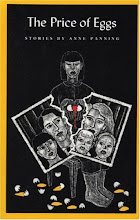
by Anne Panning
He sits in the Buick under buggy
streetlights. Scratch-offs shed
silver dust onto his jeans as if
they're molting. Later, he'll stuff dollar
winners in his underwear
drawer where they'll settle
like an insect's folded wings. Power
ball tickets curve inside his wallet, warm
and pink as the shrimp he wishes
he could afford for dinner. Each
night they accumulate in fragile
piles thin as the soft moth's wings
that hover against his battered
porch light.
Saturday, March 10, 2012
Driving Instructions: a sonnet

Driving Instructions
by Anne Panning
That night when you leave your mother's
dead body behind in the hospital, make
sure to look back one last time. Don't
forget this is finite, like the last green
slippers she knit you for Christmas
that will last one more winter, then snag
on a stray nail, unraveling right before
your eyes. And whatever you do, take the car
keys from your father, who will insist on driving
home even as the sky clots orange
with clouds of forgetting. "Anyone know any good
jokes?" he will say as he barrels down
the freeway, fine tuning the radio. Say:
no. Say: not yet. Say: let's slow down.
~Lake Affect Magazine, 2011
Wednesday, January 4, 2012
Eight Things You Should Never Buy Generic

1. Ketchup. It's got to be Heinz. Hunt's isn't as sweet, plus it's kind of pulpy, and let's not even talk about generic. Interesting side note: when I was in Peace Corps/Philippines, I learned to eat banana ketchup on almost everything. It was pale orange in color (not sure why) and chunky and sweet and I'd dip jicama strips into it for an afternoon snack or smear it on rice for dinner when all that was being served was fish heads.
 2. Tape. It's got to be Scotch. I can say this after spending much of the recent Christmas season wrapping gifts with decidedly inferior store-brand tape. It's impossible to tear off; it doesn't stick adequately to most wrapping paper, and it's too skinny.
 3. Mayo. It's got to be Hellman's, though I will also accept Kraft. (Miracle Whip is an entirely different story, and worthy of its own post). When I feel scrimpy and scroogey and occasionally buy the store-brand "salad dressing," I regret it. It's is a strange orangey-yellow color; it's wiggly and gelatinous; it's fatty and too oily on the tongue.
 4. Dish soap. I prefer Dawn, but will also occasionally accept Ajax, Ivory or any name brand that doesn't smell like gross-ass lavender perfume or something. Generic will not rise up to proper bubble performance and will peter out in the sink and not cut through grease. It's sad, really.
 5. Mac and Cheese. It's got to be Kraft, or, even better, Annie's. My son, Hudson, has recently shaken up the household by introducing Velveeta mac and cheese WITH BACON. Holy shit. I thought it would be terrible but it's pretty good. The biggest problem with generic mac and cheese is how gross it tastes. And also how the powder doesn't mix well.
 6. O.J. Anything but generic, which is watery and sour—a dreadful combination.
 7. It's got to be Jiff or Skippy. Good luck trying to spread generic on your soft bread. It'll rip it to shreds.
 8. Diapers. Pampers or Huggies. This one is not negotiable. If you've ever had a baby, you know that cheap diapers do not contain those little curry-colored explosions newborns are prone to, or, god forbid, the later king-size toddler dumps.
 ...unless you're broke, of course (which I have been many times throughout my life), in which case, who cares! Anything goes.
Wednesday, November 2, 2011
Kindle-ing?

I have a Kindle in my possession. I did not buy it. I borrowed it from the university library where I teach. I got it because I needed to review a library book for a graduate class I'm teaching that was only available as an e-book. As luck would have it, the Kindle was not able to "accept" this e-book because of proprietary amazon issues.
I brought it home anyway, curious.
My children, Hudson (10) and Lily (7), love the Kindle. They think it's great fun to push buttons instead of turn pages. They like zooming around the menu, "bookmarking" their pages, and clandestinely hooking up to wifi. They've been reading fairy tales on it (it came preloaded with these) as well as Treasure Island. Once I came home from work and Hudson was sitting on the couch, reading on the Kindle while it was plugged in, charging. This struck me as strange, unsettling.
Last Saturday afternoon, I found myself finally with some free time to spend with the kids. I said, "Would you like me to read to you both?" and they said yes, then gathered on either side of me on the couch. The first book I read was Fly High, Fly Low by Don Freeman, about two pigeons who live in a big letter "B" atop a New York City building. It was an old discarded library book, hardback with a crunchy cellophane cover. We marveled at the muted oranges, reds, and purples of the sunset the illustrator must have done with charcoals. I ran my finger over one of the pages it was so beautiful.
Next, I read a fairy tale "Little Two Eyes" on the Kindle. I held the plastic rectangle between the two kids, and they argued over for got to push the "Next Page" button each time. There were no pictures. Both kids, I noticed, physically pulled away from me a bit until it was time to push "Next Page." And funny thing—we didn't really know when to stop. Was it a long story? I did notice there were numbers on the bottom of the Kindle, "11%, Locations 424-28, 3790." Were these page numbers? Or was I to assume we were 11% done with the story? Neither, I realized.
I've found myself reacting not against the Kindle, but instead, uninterested in the Kindle. It sits in the living room in its little black case, and though I glance at it, I have not yet been inspired to use it for my own reading. Why is that? I wonder. A. I'm at home. I have books everywhere, all around me. B. There are so many steps to reading on a Kindle. Turn on. Home. Menu. Select text. Press "next page" button. And then, reverse all of these steps when you're done. C. It's plastic and doesn't feel right in my hands. D. It's only the size of half a book. It's like reading a single page over and over. I prefer a two-page spread.
Here are some things you should know:
•I often go whole days without using my cell phone
•I do not have internet access on my cell phone
•I like to be alone a good portion of the time
•I write books of fiction and nonfiction
•I rarely answer our home telephone but stand and listen to who's on the machine
•I feel lonely quite often
•The university loaned me a Kindle 4, not the newest model, and certainly not a Kindle Fire
•I have what I call "The Panning Museum of Antiquated Technology" up in my attic, featuring things like old phones, sewing machines, primitive laptops, curling irons, ancient adding machines, a Rollodex
•"kindle" /verb/ definition: a. To light or set on fire. b. To arouse or inspire (an emotion or feeling)
Monday, September 5, 2011
Purple Slaw, Blogs and Creativity

I was chopping purple cabbage tonight for an Asian slaw recipe I love that also includes peanuts and cilantro. I like to chop it super fine and serve it in a pale bowl for color contrast. As I was chopping, I kept thinking about my creative nonfiction workshop and the blogs that I had the students create for the class. I'd just checked out how they looked, read what they wrote for their first entries, and couldn't stop thinking about them. It's hard to explain how differently the blogs are making me think about my students. It's like they're more fully present, more three-dimensional, more complex. Their blogs are like portals into their other lives that I don't get to see.
I'm not sure how this will play out, what stumbles and bumps will emerge. I do know setting it up has already proven to be much more work than the "regular" way I used to teach the workshop. Still, something about this approach is lighting a fire in my brain and heart. Their blogs let me stay connected to my students in new ways. Their blogs also allow me to witness their approaches to creativity—visually, socially, and artistically.
So far, so good.
Tuesday, August 30, 2011
Letter to Myself as a College Freshman

Dear Anne,
Welcome to college.
Do note that if you leave your gray fedora with the feather pluming off the side of it on your lamp it will definitely burn a hole in it, meaning you won't be able to wear it anymore to house parties, meaning you won't be able to wear it with your Flashdance sweatshirt while fist pumping to Prince's "1999" with a bunch of burly wrestlers and gay theatre majors that you meet at orientation, meaning you won't be found crying in the corner later when "Sister Christian" is playing and you've had enough.
As well, remember you are not the only one from a corn & soybean small town, though it will often seem as such. This is mostly fiction, and aside from the tall, blonde, Scandinavian foreign students who flock to your Lutheran college, realize that most everyone, including the tie-dye wearing Rhonda who lives across the hall from you and is already actively political with her anti-Reagan chants and her Mondale posters, is really just another shy Midwestern kid like you.
Listen to me on this: waitress. Since you're putting yourself through school and must work three jobs to do so, realize sooner than later that waitressing is the most money you can make in the shortest amount of time. Never mind that there will be lots of washed-up thirty-something men who wait tables too, and who will scrape lines of coke along the bar for you after close, and who will act extremely interested in your Shakespeare paper that's due the next day and who will want to give you rides home on their motorcycles—but resist. This will end up, if you let it, being a huge waste of time. Instead, walk home, act confident so no one attacks you, and keep your wrinkled piles of money inside a book for safekeeping. Don't ever keep tips inside the dictionary or thesaurus; it's the first place thieves look. Instead, To Kill a Mockingbird is a safe choice, but if you didn't pack that one, Catcher in the Rye is safe, too.
Relatedly, it's best not to steal textbooks from the campus bookstore if you can help it, even though The Collected Works of Shakespeare costs almost a hundred dollars. But what the hell. Do it anyway. It's the eighties and they don't yet have secret magnetic security strips tucked inside books. Surprisingly, no one will notice the huge 10 pound tome shoved underneath your sweatshirt. Consider it part of your financial aid package.
It's okay to cry.
Also, when your theatre professor with the long gray ponytail pulled up high on her head and her little dog, Zorba, by her side, tells you over and over the difference between "it's" and "its," remember it for the rest of your life. Listen when she says, "Annie, Annie, Annie! This may be one of the most important lessons you ever learn!"
Don't dance on top of the tables at Blondie's Bar during Happy Hour. This may send a message about you that you don't wish to send.
Don't feel bad when spring break finds you at your parents' house in Arlington eating frozen pizza and writing a Sociology paper while the rest of your friends are at South Padre Island. You will be better for it, stronger. Watching snow plop down off the trees outside your old bedroom window will set something off in you that will help you later. Try to be patient for it. Try.
Do not eat the ham salad at the cafeteria.
Do not under any circumstances lie to your professors, even though your old, eternally blinking, tweed-wearing religion professor would believe you if you told him you just found out your parents were getting a divorce last week and that's why you missed the midterm. Know that your very real tears would convince him. But don't do it. Please. It's beneath you.
Finally, keep a little cassette player by your bedside and listen to John Lennon's "Imagine" every night, which will comfort you while lying in your tulip sheets as I-94 and the rest of your future flies by outside the window.
Good luck. I'll be waiting for you.
love,
Anne
Monday, July 25, 2011
Read This Book #4
 I splurged and bought a hardcover of this book. I wanted a good, sprawling, multi-generational family novel to take with me on our trip to northern Michigan. Despite what the cover suggests, this is not a "beach read," but is in fact a complex, richly layered and character-driven novel. I'm so glad I splurged.
First of all, the title: Maine. There's something about the state that holds mystique, allure. What is it exactly? I've only been there once for a week's vacation when my daughter, Lily, was just a toddler and my son, Hudson, was five. We rented a small house on the ocean, and did a lot of chasing after the kids but the real highlight was celebrating my birthday by eating my very own huge lobster on our picnic table, complete with melted butter and bib. Still, Sullivan's Maine is much different here: it's the kind of old-money, family camp style Maine that you want to cozy up in and never leave.
But all is not happy and bucolic, of course. When the three generations of Kelleher women meet at the property one summer, negativity, hushed secrets, sibling rivalry and other tensions abound. Alice, the octogenarian matriarch, drinks far too much and is hatching a plan that will surprise and sadden the whole family. Maggie, Alice's granddaughter, is pregnant and thirty-two with no real prospects on the horizon; Maggie's mother, Kathleen, the black sheep of the family, has moved to California and now operates an organic worm farm. Ann Marie, related to the family through marriage, is the quintessential suburban wife and mother with a crush on her husband's good friend. They all compete, argue, one up, blame, and guilt trip one another as they realize the old and easy days are gone.
What I love about the novel is the way that each character is deeply grounded in particularizing details. Ann Marie is obsessed with dollhouses, and so we get a firsthand look at the culture of miniatures. I was intrigued by the organic composting with worms Kathleen is engaged in, and I was equally taken by the subtle way Alice's Irish Catholic background informs her present decision making.
Idiosyncrasies: Four revolving narrators spanning three generations; the dollhouse convention Ann Marie attends (fascinating look at peoples' obsession with "the small"), the way readers are privy to the novel's "secret," but that three of the four narrators aren't
Favorite line: "Minnie's Minis from Staffordshire made the most gorgeous little cakes, with frosting that looked like real marzipan, and tiny ceramic strawberries on top, each berry no bigger than the head of a pin. A slice of cake could be removed to show the chocolate and raspberry filling inside."
Bottom line: A rich and elegant novel with the beautiful setting of Maine that invokes a longing for the past and questions the durability of family ties
Tuesday, July 12, 2011
Read This Book #3
 Desperate for a new book to read, I bought this novel by Martha McPhee, thinking: I wonder if she's the daughter of the famous writer, John McPhee, which indeed she is. Clearly, literary talent runs strongly in the family.
Though some reviews call this book a Pygmalion story, a social satire, or even a “morality tale of the early 21st century greed and fall,” I found it quite simply a captivating read. The basic plot line revolves around India Palmer, a well-published but cash-strapped novelist living in New York City with her artist husband, Theodor, and their two children. When she finds herself living far beyond their means and trying to keep up with the “Joneses,” she meets, at a cocktail party, Win Johns, a Wall Street millionaire who makes a bet with her that if she’s willing to give it a go on Wall Street, he’ll make her a “world-class bond trader” within eighteen months. What follows—her resistance gradually corroded by her desperate desire (and need) for money—is oddly gripping. Will she make it? you ask yourself. And if she does, at what cost?
Favorite Line:
“At Bergdorf’s, I bought a new dress, a rich brown macramé for fall. The price: $775. A tax deduction, I thought. I just had to have it to wear to my book party. I shared my strategy with Lily, and we both laughed about the deduction. ‘An absolute expense,’ she said. 'I’ll serve as witness if the IRS comes after you. Kind sirs, she only wore it that once. She had to look like a million bucks, otherwise who’d buy her book?’”
Idiosyncrasies:
Surprisingly original “good guy- bad guy” characters, such as Lily Starr, her long time writer friend who makes it big and flaunts it in her face, and Snake, a young cut-throat bond trader from Calcutta who befriends her; a hamburger eating contest that will make you nearly vomit; an inside look at what exactly happens on Wall Street and how it works (I found this fascinating).
Bottom Line:
A great story about art versus corporate America right before the banking bubble is about to burst. Gripping, sly, funny, and thought-provoking. Also, I was surprised by how fervently I (a writer) found myself rooting for her to succeed on Wall Street.
Monday, June 27, 2011
Read This Book #2

I must admit I don't read a lot of British fiction, contemporary or otherwise. I'm small-minded that way. I find it too stuffy, too cold, and yes, those British idiosyncrasies like single quotation marks for dialogue, Old World spellings and idioms (tyre, flat, lift, storeys) and the constant drinking of tea and biscuits with "Mum," are too precious for my taste. But when good crime fiction meets "literary" fiction, I'm helpless against it.
The novel opens with the protagonist Beatrice getting a call that her younger sister Tess is missing, and so she boards the first flight she can get from New York to London. Already I love the idea, since I'm a big fan of missing persons fiction, but as the story unfolds, strange surprises keep cropping up about her sister. One of the things I love is the way the author plays off opposites; Beatrice is the sensible, responsible sister while Tess is a bit of a Bohemian, but instead of treating this dichotomy in a simplistic fashion, Lupton shows the complexity and difficulty of the relationship.
Favorite line: "When I saw your strand of hair I knew that grief is love turned into an eternal missing."
Idiosyncrasies: The entire novel is written in an epistolary fashion, that is, as a letter written from Beatrice to her younger sister, Tess. At first this felt a bit awkward, but then I relaxed into it and saw how perfectly it gave the book shape and structure. There is also intrigue involving medical ethics that gives the novel an even broader social reach.
Bottom Line: One of the most gripping climaxes I've read in a long time. The mystery of what happened to her sister, and the lengths to which Beatrice is willing to go to find out, had me hooked. I sacrificed sleep to finish this one.
Wednesday, June 8, 2011
Hometown: Revised

Recently I flew home to Minnesota because I missed my siblings and needed to be among them. I'm also working on a memoir set there, so I needed to see and feel and touch all the things I was writing about. I wanted to tour the trailer court in Arlington where I had spent the majority of my childhood. I wanted to drive down Main Street and check out my dad's old barber shop. I wanted to place flowers and a note on my parents' gravestone. I wanted to check on the status of their old Victorian house.
I did all these things and more, thanks to my sister, Amy, and her husband, Dan, who drove me around in their minivan. They were patient as I popped out of the van to take photographs, jot down notes, and sometimes asked for a second, or even a third, cruise-by of something that caught my eye.
I'd like to report feelings of nostalgia and a deep connection to the place, but the fact is, it was complicated. Without my parents, without a single relative drawing me back there, Arlington had become exactly that: just a place. Sure, there were sweet spots of memory. "Over there," I told Amy and Dan's kids as we drove by the high school, "is where I had my first kiss with Tony O'Brien. Right by that dumpster. Fourth grade."
But as we drove out of town, I wondered: when would I ever be back here again? I'd long since gotten everything I wanted from my parents' house. Most of my old friends had moved away. Without a single family member left in Arlington, there would be very little reason to come back, and the thought filled me with sadness.
* * * *

Back at Amy's house in Montgomery, Minnesota, I had an epiphany: this had become my new "hometown." Each time I visited, new habits had emerged, little traditions that I looked forward to each time:
1. Buying teriyaki turkey jerky at Edel's Meat Market (Monty boasted 3 different meat markets!)
2. Going out for "the best Blood Marys in 17 Counties" at Neaner's White Front Bar
3. Shopping for clothes at Bargain Betty's consignment shop (actually in New Prague, one town over, but still a constant for us)
4. Getting a kolacky (fruit-filled Czech pastry) and coffee at Franke's Bakery
5. Going to see Dan at Fransden Bank and getting a free pen
6. Shopping the dollar aisle of Herman Drug (scored a cool Mood necklace for Lily)
7. Doing a photo shoot with Amy in her studio (she could get me to smile without looking one bit fakey she was so good)
8. Drinking wine on Amy and Dan's deck overlooking undulating hills, a pond, and a horse farm all glowing in the buttery Midwestern light
* * * *
I still dream about Arlington sometimes at night: the long windows of my bedroom curlicued with intricate ice patterns, my mother's kitchen and its apple wallpaper border, the mint green water tower rising up over corn fields, the Christmas lights hung year-round on the feed mill, the diagonal parking on Main Street. These things will never leave me.
As Ray Gonzalez writes: "I do not believe in the loss of home...You can celebrate or mourn the area where you grew up, but you have earned them and can't abandon them completely."
Tuesday, May 17, 2011
Happy Birthday, Lilypalooza!
 Seven years ago today I had a baby in what was called a "precipitous" birth, i.e. so insanely fast there wasn't even time to get a doctor in my room at the hospital. One minute I was eating an apple on the couch at home, and less than an hour later, I was holding a baby in my arms in the hospital that was a 30 minute drive way. I was still in the red t-shirt I'd been wearing. My hair wasn't messed up; my eyeglasses weren't askew. Aside from looking a little stunned, I look as I normally did on any regular day.
We already had a son and desperately wanted a girl since this would be our last child. When Mark said, "It's a girl!" I said, "Are you sure? Check again because you HAVE to be sure!" He checked again. "It really is a girl," he said. "Annie, we got a girl!"
We had a girl's name all picked out: Lucy. It wasn't even a question, until I held her in my arms and something shifted. "I don't know," I said to Mark. "I'm not sure what we should name her." Then Lily popped into my head. It was deep and fragrant spring; everything was in bloom, and lilies had always struck me as elegant but sturdy flowers. I decided I wanted a daughter who was elegant but sturdy. Mark took no convincing. He wrote her name on the dry erase board in my room: Lily Kahala Rice Panning. And it was decided. For several weeks afterward, I accidentally called her Lucy. She likes to hear this story now. "Can you even imagine me as a Lucy?" she'll say. I cannot.
Below are photos as follows, 1) Lily on a regular old day in our sun room, 2) Lily with her new purple soccer ball from Hudson, 3) Lily in her new GIRLS ROCK t-shirt from Auntie Amy, 4) Lily trying out the bongo drums from Mark, 5) Lily and I after our first run together this past Mother's Day.
How grateful I am for this feisty energetic girl. I know one thing: holding onto her unwavering confidence in herself is going to be my life's mission all the years ahead. We can do it, Lily. GIRLS ROCK.


Sunday, May 15, 2011
Read This Book! #1

Driving With Dead People: A Memoir by Monica Holloway (Simon Spotlight Entertainment, 2007).
I found this book in my local thrift store, hardback, for $1.00. I remember when it had come out, and thinking that it looked good, if a bit gimmicky. But for one dollar, who cared? The gimmick factor was there to some extent: the young narrator had spent time with a childhood friend whose family owned a mortuary. She and her friend would lie in the coffins for fun and pretend they were dead. Later, she would actually witness dead bodies being embalmed and drive around in the family’s hearse.
That’s interesting, I thought, as I began to read, but I wondered how far you could really go with something like that. But that’s exactly it: the mortuary/dead people aspect of the book—though it does serve as a loose through-line—is never the focus of the memoir. Instead, it’s the narrator’s relationship with her family, particularly her father (who drives all over their small Ohio town videotaping car wrecks and gruesome accidents) that cranks up the book’s tension. There’s also a family betrayal that Holloway gradually uncovers that makes the book a true page-turner right up until the last page. As the author's website puts it: "This is ultimately a memoir detailing her bizarre, often funny and ultimately terrifying life growing up in a small Midwestern town." But it's so much more than that.
Favorite Line:
“Dad had pulled some horrendous stunts, but when he fucked with Mom’s love of the Great Smoky Mountains, he’d gone too far.”
Idiosyncrasies:
the narrator’s acting career in L.A., her little blue motorcycle, the many 1970s pop culture references (The Carpenters, Mrs. Beasley, The Beverly Hillbillies, Polaroid Instamatic), her sister's memories presented in italics as her own
Bottom Line:
I fell in love with this narrator. She’s funny and strong and ‘effed up and I want her to be my friend.


.jpg)


